



DEFENSIVE ARCHITECTURE
Both prehistoric and ancient defensive elements as well as the medieval military construction of the Alpujarra, show an important deterioration. However, the remains that can still be seen provide important information from a technical and historic perspective. Apart from them, there is a series of defensive structures from later stages.
Castles and castillejos, fortresses and walled cities
Notable elements belonging to the medieval period stand out, although these are not the only ones.
- Lanjarón Castle. Construction built between 13th-15th centuries. It is organised on the basis of two delimited rooms to which one can access through a double bend door. It has a water tank close to the entrance. Its main function was to protect the ways that go from Granada to the coast.
- Poqueira Castle. Located in a strategic area that allows the vision of the Poqueira Ravine, Trévelez river and the Corona mountain.
- Juviles Fortress. The remains of three water tanks and some parts of the wall are found.
- Escariantes Castle, located in Ugíjar. It was inhabited at the beginning of the Muslim conquer in the peninsula.
- Juliana Castle. Built not very far from the Murtas. Its remains date back to the 8th century. Some towers of its perimeter still stand. Inside, remains from houses and two water tanks can be observed.
- La Rábita Castle. It is settled over an Arab ribat (from which a big tower is preserved) and it was an essential element to defend the coast of the Alpujarra.
- Castell de Ferro Castle. One of the best-preserved defensive constructions of the region. In the Christian time, it survived because of its excellent location for the maritime control. Its structure consists of three parts: the Homenaje Tower, which has Muslim origin, is the main building. Opposite it, a space of a later period is found. Its rooms are devoted to the garrion and to the patio. Finally, there is a bastion from the 16th century for artillery pieces.
- Baños Castle (Polopos-La Mamola). It is dated in the second half of the 18th century and is built over a semi-circular horseshoe-shaped floor. Two lateral towers extend this horseshoe.
- Guardias Viejas Castle. Located in El Ejido, it dates back to the 18th century. Inside, it has a valuable collection of military elements of the time.
- Laujar Alcazaba of Andarax. It was the house of Boabdil during the exile, after having given the city of Granada to the Catholic Monarchs. During the Nasrid stage, the fortress is proclaimed to be the most important in the Alpujarra.
- Marchena Alcazaba. Located in the territory of Terque, in the middle of Andarax. Remains of walls and water tanks can be found nowadays.
- Fiñana Alcazaba. 9th-10th centuries. There are remains of three towers and part of the walls, a water tank under the current access to the construction, the clock tower (watchtower of the ensemble) and an important restored water tank.
- Villavieja Alcazaba. Located closed to the municipality of Berja. Currently remains of a rectangular tower, parts of the wall, water tanks and possible habitable structures are found.
- Adra walled city in the 16th century. Located closed to the sea. Its defensive character excels.
Defensive Towers
Shelter towers
Some of these towers have been restored, as it is the case of La Estancia (Gualchos-Castell de Ferro).
Because of the fear of the continuous Mudejar revolts, the old Christians set some points to provide shelter. In some cases, the church towers were used, such as in the case of the Torre del Convento of the Augustinian of Huécija.
On the other hand, the wealthiest families could afford the construction of these towers next to where they lived. As an example, in the region, the Tower of Enciso can be found in Berja. It dates back to the 16th century.
Coastal towers
- Cylindrical towers from the Muslim times.
- Small towers from the beginning of the 16th century.
- Towers from the 18th century.
Important examples here are the Tower of Rijana, located next to Castell de Ferro. It was built in the 16th century over medieval remains, possibly from the 10th century. Around it, some remains from a walled place are found. Outside, there are also two water tanks. In the 18th century, the place was abandoned because of the scarcer visual communication with the rest of the defensive coastal towers.
Trenches and Bunkers
The remains from the defensive constructions built in the Alpujarra during the Civil War can be considered an asset.
Examples of this are the trenches and bunkers of Pico Águila and its surroundings. The Bunker of the Cascajar Negro in Capileira is worth to be mentioned too. To defend the city of Almería, in the mountain of the Tahonas in Bentarique there are some samples.
ARCHITECTURE IN THE ALPUJARRA
Traditional architecture in the Alpujarra
The traditional house in the Alpujarra has a Berber origin and can be found in narrow streets that tend to be horizontal. The whole forms terraces that are inscribed within the town.
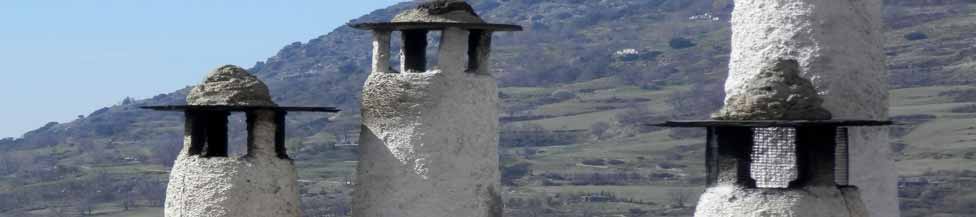
The houses usually can be simple and whitewashed constructions of one or two floors with covers or flat roofs of magnesium clay and truncated cone shape chimneys. Stone and wood are the basic materials used to build.
These houses usually have few or very small holes or openings to preserve the heat inside in the winter and the cold in the summer. Normally, they do not have balconies and the doors are very simple, with only one piece or divided in the superior part. The furniture is normally scarce or very functional.
The inside is filled with mortar (gypsum or mud) and the space is normally divided into several floors:
- Low floor. With rooms for economic usage.
- Medium floor. For the kitchen, larder and rooms.
- Top floor. With warehouses for products or drying places for fruits and seeds.
The tinaos
In the city, the tinaos play an important role. They could be like an extension of the house. These are platforms that cover part of the streets or the whole, and they are crossing points. They can also be used to be protected from the inclement weather or as a drying place.
Nobles’ and bourgeoisie’s houses
Houses of people with a higher buying power. They look like traditional houses, but they are bigger and more sumptuous, as they represent the richness and power of the families that live there.
These buildings have normally three floors. They will appear in the 17th and 18th centuries. They are made out of brick with masonry of Mudejar patrimony. The facades are made of stone and also have the familiar shield, a big balcony of forge, pediments over openings, as well as opened loggias on the third floor.
As an example of this, the House of the Godoy and Moral families in Fondón can be mentioned. A wonderful watchtower in a lateral is the most important element in the House of Los Palomar or the Rey Chico, in Fuente Victoria, from the 18th century. The notable Palace of the Counts of Sástago, in Órgiva, dates from the same century and was built from a Muslim tower.
During the 19th century, the bourgeoisie’s houses will not use materials from the region any more. They will be built with “market materials”. They excel because of its ostentation and profuse decoration. The house of Los Caballitos, in Terque, is one of this. It has two floors and consists of two modules joint together. Over a cornice, there are some eye-catching figures of gryphons that, as they are wrongly identified with horses, give name to the house.
Administration, commerce and free time buildings
- Town halls. The buildings from the 18th century stand out. The Cádiar one, a manor house of three floors, is a good example of it, as well as the one from Berja.
- Grain storage cooperative. Wheat barn of municipal management mainly. Some of the oldest ones are the Fondón one and the so-called Fuente Victoria, both from the 16th century.
- Public schools. Created mainly after the Age of Enlightenment. The schools for children of Alsodux date back to 1928. They are eclectic buildings.
- Markets. They are located in places like the Public Markets. The market of Berja, for example, was built around the second decade of the 20th century.
- Casinos. They have been very common in the towns of the Alpujarrra with a higher economic status. The Ancient Casino of Ohanes from 1905 stands out.
ACCESS ROADS: ROADS AND BRIDGES
The steep territory of the Alpujarra has presented big difficulties of accessing through history. This has generated a series of roads, with bridges, that has resulted in an extensive regional road network.
The bridges are a very typical element of the Alpujarra. There are even some from the Roman and medieval periods (both Muslim and Christian).
There are some examples that stand out such as the Roman Bridge of Mecina Bombarón or the Bridge of the Tableta in Válor. With an iron architecture, there are interesting bridges in the region, such as the one of Cherín. The Bridge of Alcolea river is made out of reinforced concrete and it is located in the municipalities of Ugíjar and Alcolea.
There are also some interesting examples of suspension bridges that are less complex but very interesting, such as the Suspension Bridge of Benecid, between this municipality and Fondón.
Inns and lodging houses
To help the users of all these ways that compose the Alpujarra, inns and lodging houses were built. There are some old places of this type that worth to be mentioned, such as the Lodging House of the Cojo in Cádiar.